


Professor Zhang Chen's team from the School of Basic Medical Sciences reveals the mechanism by which gut microbes alleviate Alzheimer's disease in Cell Metabolism
Recently, the research team led by Professors Chen Zhang, Wei Wang, and Xicheng Liu from the School of Basic Medical Sciences, Capital Medical University, published an online research paper entitled "Microbiota-derived lysophosphatidylcholine alleviates Alzheimer's disease pathology via suppressing ferroptosis" in the international journal Cell Metabolism. The study found that gut microbiota dysbiosis, characterized by a decrease in the abundance of Bacteroides and an increase in the abundance of Clostridium, is one of the pathogenic factors of Alzheimer's disease (AD). It also verified the regulatory effect of a single bacterial species on AD pathology, providing a theoretical basis for future microbiota intervention therapies for AD. Dr. Xu Zha (postdoctoral fellow) and Professor Xicheng Liu from the School of Basic Medical Sciences, Capital Medical University, are the co-first authors of the paper. Professor Chen Zhang (last corresponding author), Professor Wei Wang, and Professor Xicheng Liu are the co-corresponding authors.
Alzheimer's disease (AD) is a progressive neurodegenerative disorder primarily characterized by the deposition of β-amyloid (Aβ) plaques. As the main type of senile dementia, the efficacy of existing treatments for AD is limited. Thus, there is an urgent need to further explore its pathogenesis and develop new prevention and treatment strategies. It is known that the gut microbiota can regulate emotions, cognition, memory, and other functions of the body through the gut-brain axis, and there is a close association between gut microbiota dysbiosis and the onset of AD. However, the specific changes in the composition of gut microbiota during the progression of AD remain unclear, and the impact of such changes on the AD process as well as the underlying mechanisms are yet to be elucidated.
The research teams led by Professor Chen Zhang, Professor Wei Wang, and Professor Xicheng Liu have long been focused on studies related to the gut microbiota and the pathogenesis of AD. In the AD mouse model, the teams found that the increased abundance of Clostridium and decreased abundance of Bacteroides are key features associated with β-amyloid (Aβ) burden, which leads to a reduction in the serum level of lysophosphatidylcholine (LPC) in mice. They also discovered that supplementation with Bacteroides and LPC can reduce Aβ plaque burden, rescue synaptic function, decrease gliosis, alleviate myelin degeneration, and improve cognitive impairment. Mechanistically, the study revealed that LPC, as a ligand for the GPR119 receptor, can activate GPR119 and then downregulate the expression of the key ferroptosis gene ACSL4 via the transcription factor NRF2, thereby inhibiting ferroptosis and further ameliorating AD pathology. Analyses of fecal and serum samples from AD patients showed that the abundance of Bacteroides in the feces of AD patients is decreased, and the serum level of LPC is also reduced, suggesting that this study has important clinical application value.
The research identifies a novel gut microbiota-driven pathway that regulates AD pathology, indicating that intervening in the gut microbiota and its related metabolites is expected to become a potential approach for AD treatment.
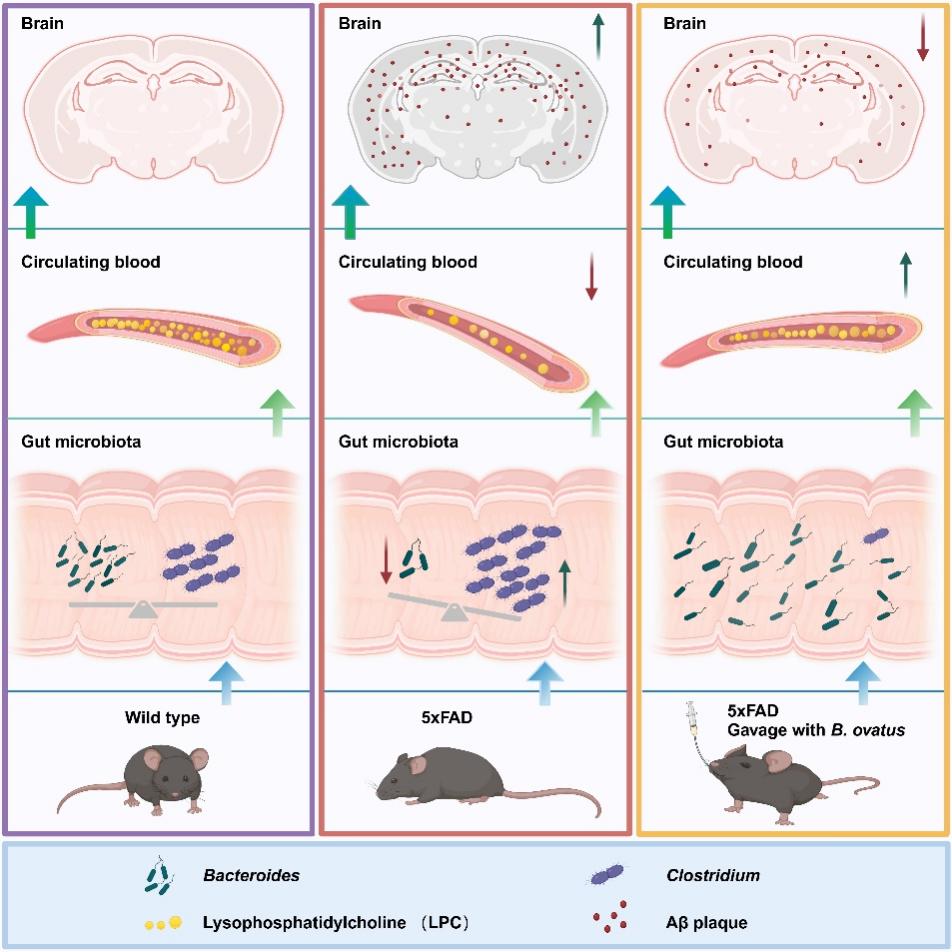
Figure: Mechanism by which gut microbes alleviate Alzheimer's disease via LPC
This study was supported by the National Natural Science Foundation of China for Distinguished Young Scholars (81925011), the Integrated Project of Major Research Plan (92149304), the General Program (82073126, 32171120, 31871147), the Youth Beijing Scholars Program (015), the Key Research and Development Program of Guangdong Province (2019B030335001), and the Joint Project of Beijing Municipal Commission of Education and Municipal Foundation (KZ202010025038). It also received support from the Beijing Institute for Brain Science and Brain-Inspired Intelligence, the State Key Laboratory of Translational Medicine and Innovative Drug Development, and the Beijing Laboratory of Oral Health.