


Research Team Led by Professor Zheng Junfang from School of Basic Medical Sciences Reveals Novel Mechanism of YTHDC1 Lactylation in Promoting Renal Cell Carcinoma Progression
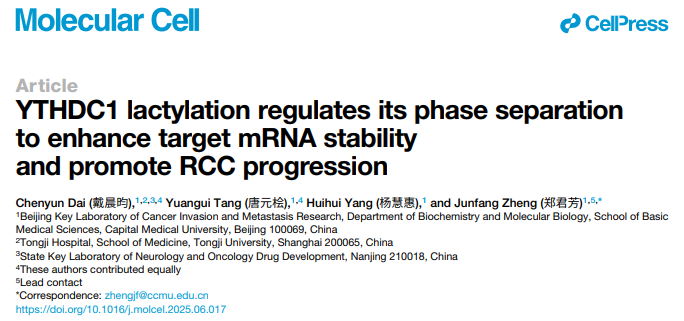
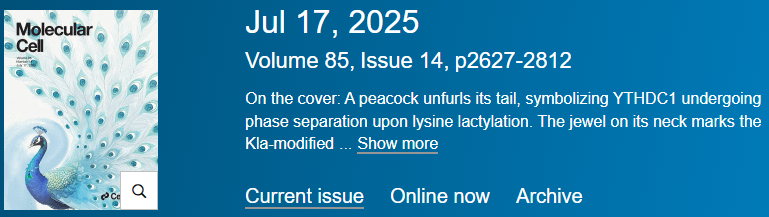
Recently, the research team led by Professor Zheng Junfang from School of Basic Medical Sciences at Capital Medical University published a groundbreaking study titled “YTHDC1 lactylation regulates its phase separation to enhance target mRNA stability and promote RCC progression” in the prestigious international journal Molecular Cell, where it was featured as the cover article of the issue. The study unveils how lactylation modification enhances the phase separation capability of the m6A reader protein YTHDC1, thereby protecting its target mRNA transcripts from degradation by the polyA eXosome-targeting connection (PAXT) complex and driving renal cell carcinoma (RCC) progression. This discovery provides a promising new therapeutic target for RCC treatment. Dr. Chenyun Dai from School of Basic Medical Sciences was the first author, Professor Junfang Zheng was the corresponding author.
Lactylation modification has emerged as a key regulatory mechanism in recent years, influencing various physiological and pathological processes, including tumor progression. RCC, a common solid tumor, thrives in a hypoxic, lactate-rich microenvironment that favors lactylation. However, the role and molecular mechanisms of lactylation in RCC progression remained unclear.
Using pan-lactylation antibody profiling, the study found elevated lactylation levels in RCC tissues, correlating with disease progression and suggesting a critical role for lactylation in RCC development. Through lactylomic analysis of RCC cells under hypoxia, the team identified hypoxia-induced lactylated proteins enriched in RNA processing pathways, with the m6A reader protein YTHDC1 being a key target. The K82 site was pinpointed as the primary lactylation site, regulated by the acyltransferase p300 and the deacylase HDAC3. Hypoxia significantly increased K82 lactylation (K82la) by enhancing the interaction between p300 and YTHDC1.
To investigate the functional impact of YTHDC1 K82la, the researchers established cell lines and xenograft models with de-lactylation-mimicking (K82R) and hyper-lactylation-mimicking (K82T) mutations. Results showed that RCC cells with elevated K82la exhibited enhanced migration, invasion, tumor growth, and lung metastasis, whereas K82R mutation suppressed these malignant phenotypes. Clinical samples further confirmed that high YTHDC1 K82la levels were associated with poor prognosis in RCC patients, underscoring its pro-tumorigenic role.
Mechanistically, the K82 site resides in YTHDC1’s N-terminal intrinsically disordered region (IDR), a key domain mediating phase separation. Hypoxia-induced lactylation was found to promote YTHDC1’s liquid-liquid phase separation, forming larger nuclear condensates. YTHDC1 K82la strengthened its binding to oncogenic mRNAs (BCL2 and E2F2), sequestering them within condensates and shielding them from PAXT-mediated degradation, thereby maintaining their stability and high expression. Rescue experiments demonstrated that E2F2 and BCL2 partially reversed the tumor-suppressive effects of the K82R mutation.
This study, employing lactylomic profiling, is the first to reveal how YTHDC1 K82 lactylation regulates target mRNA stability via phase separation. It deepens our understanding of non-histone lactylation in the tumor metabolic-PTM-phase separation-transcriptional regulatory network and offers new insights into the spatiotemporal control of gene transcription. The findings also lay a theoretical foundation for developing lactylation- or YTHDC1-targeted therapeutic strategies.
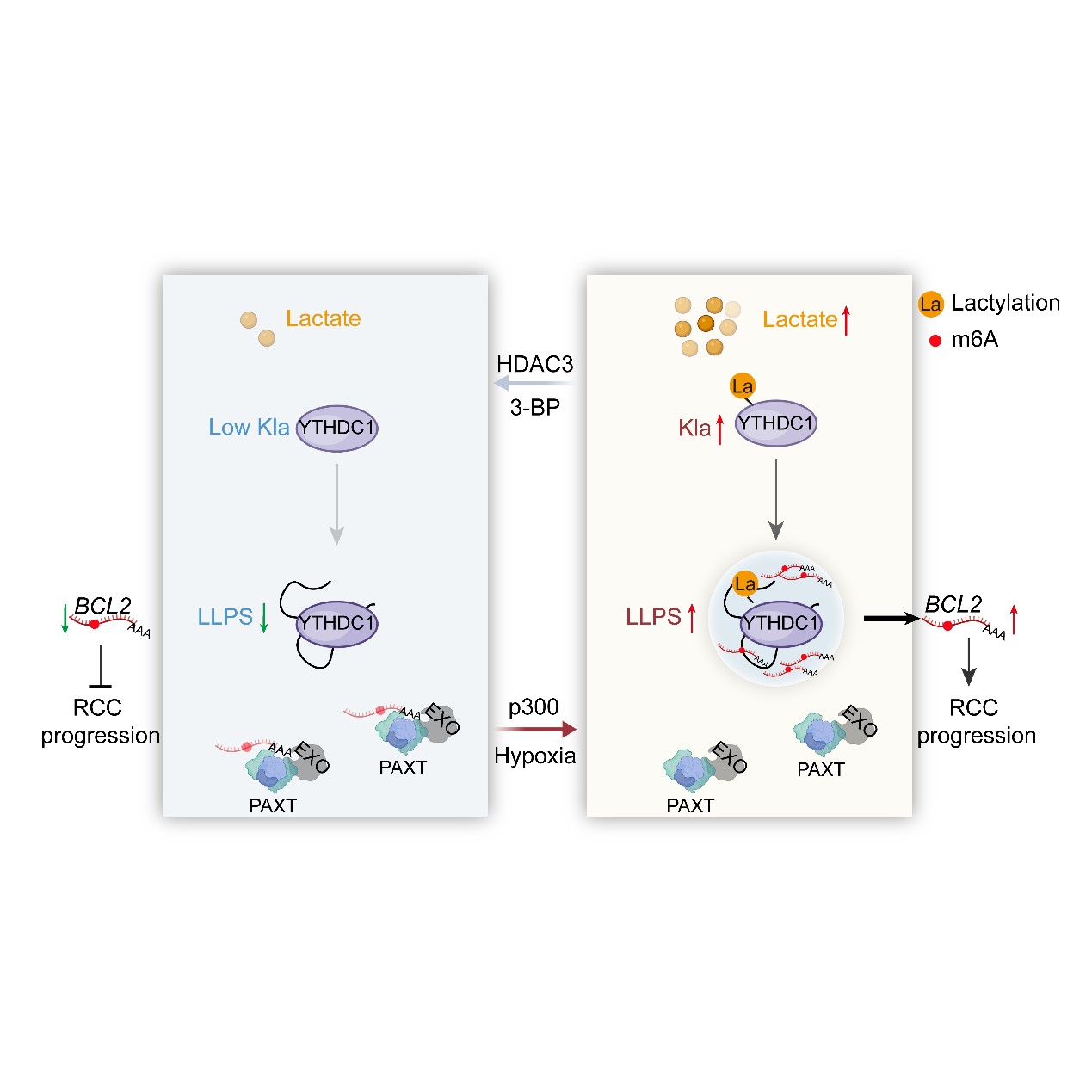
Figure Schematic diagram of the mechanism by which YTHDC1 lactylation promotes RCC progression
This research was supported by grants from the National Natural Science Foundation of China (82172923), the Beijing Nova Program Cross-Disciplinary Project (20230484483), and other funding sources.
Corresponding Author Profile:

Zheng Junfang, Ph.D., is a Professor and Doctoral Supervisor at Capital Medical University. Her research focuses on tumor progression mechanisms and the identification of tumor biomarkers. She has been honored with titles such as the Beijing Nova Program Award, Beijing Outstanding Talent, and Beijing Higher Education Young Top-Notch Talent. She has led multiple projects funded by the National Natural Science Foundation and the Beijing Natural Science Foundation, publishing extensively as a corresponding author in high-impact journals including Molecular Cell, Oncogene, Cell Death & Disease, International Journal of Biological Macromolecules and Free Radical Biology and Medicine.