


Professor Zhiqiang Yan’s Team published in Neuron revealing that TMEM63B functions as a mammalian hyperosmolar sensor for thirst
On March 18, 2025, Professor Zhiqiang Yan's research team published a research article titled "TMEM63B functions as a mammalian hyperosmolar sensor for thirst" in the top international journal Neuron. This study revealed the excitatory neurons in the subfornical organ detect osmotic changes through TMEM63B to trigger thirst-related behavior. This research was led by Professor Zhiqiang Yan from the School of Basic Medical Sciences in Capital Medical University and Chinese Institutes for Medical Research, Beijing. Co-first authors include Capital Medical University postdoctoral fellow Wenjie Zou, the Hong Kong University of Science and Technology PhD candidate Siqi Deng, Southern University of Science and Technology master's graduate Xingyu Chen, and Capital Medical University master's graduate Jiamin Ruan. Collaborating authors include Huize Wang from Chinese Institutes for Medical Research, Beijing, Wuqiang Zhan from Shenzhen Bay Laboratory, Professor Zhiyong Liu and his PhD student Jingxin Wang from the Center for Excellence in Brain Science and Intelligence Technology of Chinese Academy of Sciences
Thirst drives animals to restore water homeostasis by fluid intake. Previously, the prevailing hypothesis was that thirst primarily manifests as a sensation of dryness in the mouth and throat. However, current research indicates thirst is essentially a regulatory response to changes in blood status. Specifically, when plasma osmotic pressure rises or blood volume decreases, thirst is triggered, driving animals to actively seek and consume water to restore these blood parameters to normal physiological levels. The core of this regulatory system lies in the "thirst neural hub" composed of the subfornical organ (SFO), organum vasculosum of the lamina terminalis (OVLT), and median preoptic nucleus (MnPO). The SFO serves as the osmolarity information integration center, where its excitatory neurons can directly transduce blood osmolarity change. However, the molecular mechanism by which blood osmotic pressure is directly perceived and converted into electrical signals has remained an unsolved mystery.
The TMEM63/OSCA family is the largest known mechanically gated ion channel family, with its broad role in mechanical sensation gradually being revealed and performing vital physiological functions in both plants and animals. In 2018, Zhiqiang Yan's team first discovered the mechanical sensitivity of the OSCA family and resolved the cryo-EM structures of OSCA1.1 and OSCA3.1 with collaborator, publishing in Nature Structural & Molecular Biology. In 2022, the research published by Zhiqiang Yan's team in Nature Communications further revealed that the Drosophila TMEM63 ion channel participates in water homeostasis by controlling thirst-related behaviors like water-seeking, and this function is conserved across species—experiments showed human TMEM63B protein could effectively rescue behavioral defects in TMEM63 knockout flies. This finding not only confirmed the functional conservation of the TMEM63 family during evolution but also provided crucial clues for research into mammalian thirst mechanisms. Based on this foundation, Zhiqiang Yan's research team focused on mammalian TMEM63 family members, ultimately identifying TMEM63B as a hyperosmolar sensor molecule for thirst:
Initially, single-cell sequencing result first revealed the specific high expression of TMEM63B in SFO excitatory neurons. Subsequently, it was shown that action potential firing in SFO excitatory neurons significantly increased under hyperosmotic stimulation, and this hyperosmotic response was eliminated upon TMEM63B knockout. To further characterize the function of TMEM63B, experiments in heterologous expression systems demonstrated that physiological-level hyperosmotic stimuli induced calcium signals and inward currents in TMEM63B-expressing cells, while mutations at a key residue in the pore region of TMEM63B altered the reversal potentials of the hyperosmosensitive current. More compellingly, purified TMEM63B reconstituted in proteoliposomes also responded to hyperosmolarity, thereby further confirming its role as the pore-forming subunit of a hyperosmosensitive ion channel. Finally, the research team found that TMEM63B whole-body knockout and conditional knockout mice exhibited significant defects in thirst-related behavior under osmotic thirst or dehydration. Collectively, these experimental results not only clarify TMEM63B's function as a hyperosmosensitive ion channel but also provide a crucial molecular foundation for understanding the neurobiological mechanisms of thirst, establishing a complete "molecule-cell-behavior" evidence chain (Figure 1).
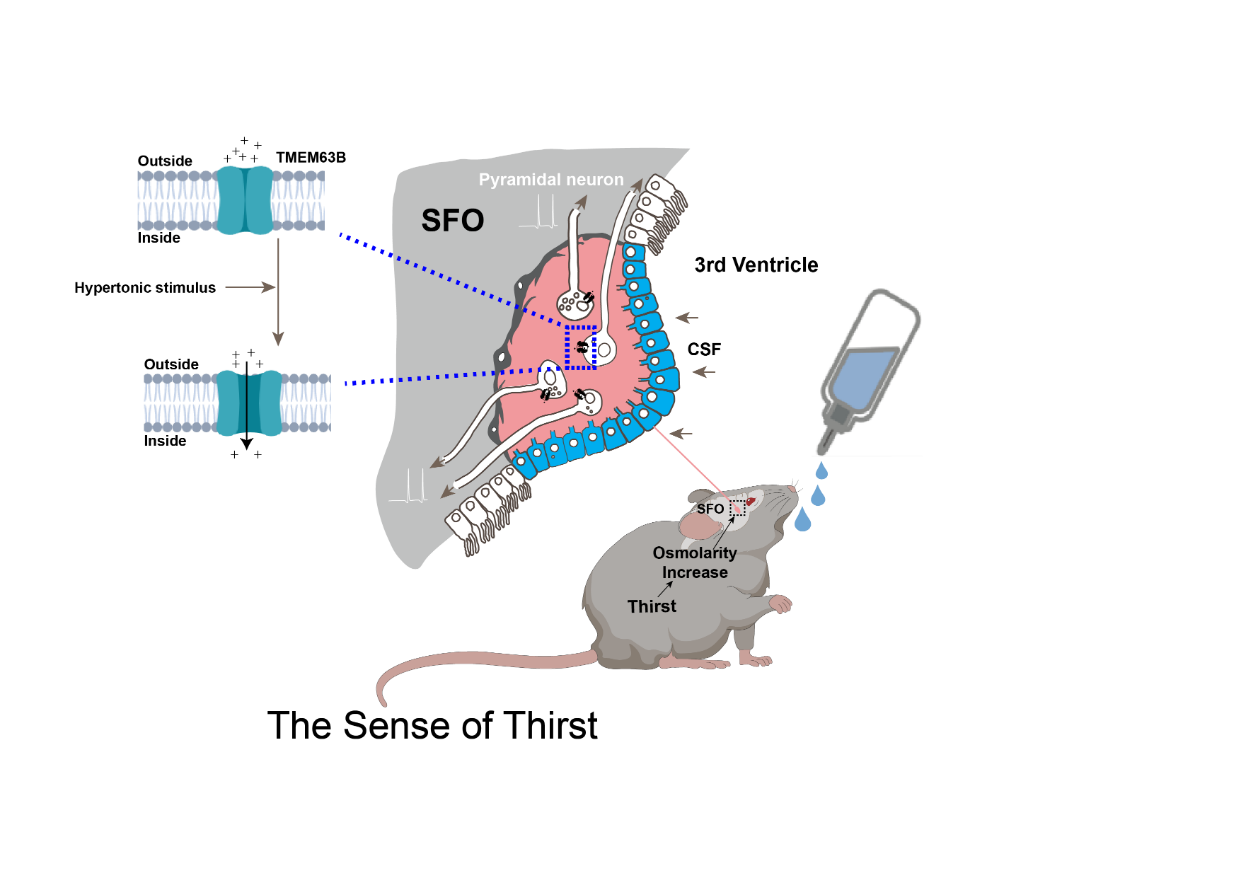
Figure 1 Schematic diagram of TMEM63B's role in mammalian thirst
This work was supported by funds from the STI2030-Major Projects (2021ZD0203304), the Shenzhen Science and Technology Program (RCJC20210609104631084), the National Key R&D Program of China Project (2021YFA1101302), the National Natural Science Foundation of China
(31970931), the Shenzhen Medical Research Funding (B2302032), and the National Natural Science Foundation of China (U23A20399).